Remember the neuter form of ‘a’/’an’ in Greek?
Ένα also means ‘one’, and is used for counting.
With your knowledge that ‘digraph’ means two letters, and ‘dipthong’ means two sounds, you might also be able to guess that δύο (dio) means ‘two’.
You can hear Lina pronounce all of the numbers from 1-40 in these videos. Follow along on page 31 of Ελληνικά Τώρα (Greek Now) 1+1:
While learning numbers can feel overwhelming, and like there’s no way to memorise them other than sheer repetition, chances are, you’re familiar with some shapes in English that will help you remember these numbers:
| τρία | Trigon (or Triangle) | 3 | 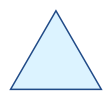 |
| τέσσερα (the Attic form was τέττᾰρες in Ancient Greek) | Tetragon (or Quadrilateral) | 4 |  |
| πέντε | Pentagon | 5 |  |
| έχι | Hexagon | 6 |  |
| επτά | Heptagon | 7 |  |
| οκτώ | Octagon | 8 |  |
| εννέα | Enneagon (or Nonagon) | 9 |  |
| δέκα | Decagon | 10 |  |
| έντεκα | Hendecagon | 11 |  |
| δώδεκα | Dodecagon | 12 |  |
These are the main words you’ll need for the hours of the day. The word for ‘time’ and ‘hour’ is the same in Greek. So, to ask the time, you would say Τι ώρα είναι; and to answer, Η ώρα είναι δύο.
If you haven’t done so already, go back and answer question 8 on page 25 of Ελληνικά Τώρα (Greek Now) 1+1.
Get a preview of all the numbers from 1-100 in these GreekPod101 videos:
Note that, as the first of these videos explains, just as ένας/μια/ένα changes depending on gender, the words for three and four do too.
Gender and numbers
When counting, the neuter words τρία, τέσσερα are used.
When describing masculine or feminine things, τρία becomes τρεις, and τέσσερα becomes τέσσερις.
It is not at all necessary to learn these words now. Simply be aware that, since hours are feminine (ώρα), Greek speakers will say Η ώρα είναι τρεις, or Η ώρα είναι τέσσερις.
Try writing out the numbers 1-30 on page 31 of Ελληνικά Τώρα (Greek Now) 1+1, and then for some extra writing practice, see if you can complete the dialogue at the top of the page.
You’ll find an additional conversation for listening practice on the Nostos website. Make sure to answer the accompanying questions on page 7 of Λοιπόν, τι λες (Well, what do you say?).
For some overall revision of what you’ve learned in chapter 1, complete activities I and K on page 10 of the Ελληνικά Τώρα (Greek Now) 1 workbook.
 greek_ciwm2e