To ask someone’s name in Greek, the standard phrase used is πώς σε λένε; (pos se lene) which literally means ‘how do they call you?’
If you want to be polite (which you probably should when meeting someone for the first time!), or if you’re asking several people their names at once, instead ask πώς σας λένε; (pos sas lene)
It means exactly the same thing, but uses the plural/polite ‘you’, σας , which you might recognize from γεια σας!
| Πώς σε λένε; | What’s your name (lit. how do they call you (s.)?) |
| Πώς σας λένε; | What’s your name (lit. how do they call you (p.)?) |
To answer, you can use the phrase με λένε… (me lene…), which literally means ‘they call me…’.
You can hear both forms of these questions, and the answer, on the Nostos website. Make sure to complete activity B on each of pages 18 and 19 in Ελληνικά Τώρα/Ellinika Tora (Greek Now) 1.
Hear lots of Greek speakers introduce themselves in this Easy Languages video:
Did you catch anyone say ‘με λένε…’?
Greek names
Many common names come from Greek, or have Greek equivalents.
The most common feminine names in Greece are:
- Μαρία (Maria)
- Ελένη (Eleni)
- Κατερίνα (Katerina)
The most common masculine names in Greece are:
- Γιώργος (Yiorgos/George)
- Γιάννης (Yiannis)
- Κώστας (Kostas)
Notice how female names tend to end with α (a) or η (i), while masculine names tend to end with ς (s).
If you come across a Greek name which ends with ‘ς‘, it’s almost certainly masculine. But you may also have heard these names said ‘Yiorgo’, ‘Yianni’, and ‘Kosta’, without the final s. There are important grammatical reasons for this.
Cases in Greek
Modern Greek contains four cases:
- nominative (which indicates the subject, i.e. who does the verb)
- accusative (which indicates the object, i.e. who the verb is done to)
- vocative (which is used to address someone)
- genitive (which indicates possession and characteristics)
Let’s say you have a Greek friend named George.
Γιώργος is the nominative case, used in sentences like ‘George (subject) watches (verb) television (object)’. It is also how his name would be written in his passport:
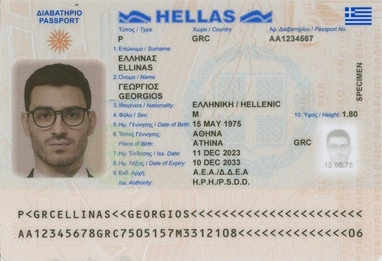
Γιώργο is the accusative case, used in sentences like ‘Maria (subject) watches (verb) George (object)‘. It is also the vocative case, used to address George directly: Γεια σου, Γιώργο!
It’s very easy to form the accusative or vocative of a masculine name or noun: just drop the final ς.
Feminine names and nouns are even easier: the accusative and vocative are exactly the same as the nominative: Μαρία is what is written in Maria’s passport, and Μαρία is both how you describe what she does and what happens to her, as well as how you address her directly.
Don’t worry too much about cases for now. All you really need to know is that Κώστα and Κώστας are the same person!
You may also know some famous Greek names from history.
e.g. ‘Οδυσσεύς (Odysseus) or ‘Ομερος (Homer).
Notice how, in Greek, both names start with omicron (Ο). Omega (Ω) is not a common first letter of names.
Grammar Focus:
Pronouns are words like ‘you’ and ‘your’ that stand in for proper nouns (i.e. we use them instead of saying ‘Elleni’ or ‘Elleni’s’). You’ve now encountered some of the most important pronouns in Greek:
| Accusative (object) pronouns | Possessive pronouns | ||
| με | me | μου | my |
| μας | us | μας | our |
| σε | you (s.) | σου | your (s.) |
| σας | you (p.) | σας | your (p.) |
Notice the relationships between these words:
- the pronouns referring to ‘I’ or a group ‘I’ am in start with m (με, μου, μας)
- the pronouns referring to ‘you’ or a group ‘you’ are in start with s (σε, σου, σας)
- the singular accusative pronouns (which indicate the person referred to is the object of the verb, e.g. the one being called in με/σε λένε) end with e (με, σε)
- the singular possessive pronouns (which indicate that a noun, like health, belongs to the person referred to) end with u (μου, σου)
- the plural pronouns end with as (μας, σας)
Note that μας means both ‘us’ and ‘our’, and σας means both ‘you’ and ‘your’.
What do these phrases mean?
- Γεια σου!
- Σας ευχαριστώ.
- Πώς σε λένε;
- Γεία μας!
Bonus: Your name in Greek!
Many common first names come from Greek, or have Greek counterparts.
Wikipedia and baby names websites are a good resource for discovering whether your name has a Greek equivalent.
If it doesn’t, you can write your name using the Greek alphabet by sounding it out.
e.g. Kim → K-i-m → Κ-ι-μ → Κιμ
or Lucas → L-u-c-a-s → Λ-ου-κ-α-ς → Λουκάς
or Jenny → J – e – nn – y → Τζ-ε-ν-ι → Τζένι
| English letter | Greek letter(s) |
| A | α (for an ‘ah’ sound, e.g. Marc) ε (for an ‘eh’ sound, e.g. Mary) |
| B | μπ |
| C | κ (for a ‘k’ sound, e.g. Marc) σ (for an ‘s’ sound, e.g. Lucy) |
| D | ντ |
| E | ε |
| F | φ |
| G | γκ (for a ‘g’ sound, e.g. Helga) τζ (for a ‘j’ sound, e.g. Gerry) |
| H | χ |
| I | ι (common in borrowed words) η (common ending for female names) υ |
| J | τζ |
| K | κ |
| L | λ |
| M | μ |
| N | ν |
| O | ο |
| P | π |
| Q | κ |
| R | ρ |
| S | σ/ς (final letter only) |
| T | τ |
| U | ου |
| V | β |
| W | οι |
| X | ξ |
| Y | υ |
| Z | ζ |
How do I choose which vowels to use?
Greek has multiple ways to represent an ‘i‘ sound like the i in Kim. The most commonly used in borrowed words and names (like Kim) is iota (ι) – Κιμ.
Conversely, there is no single letter that represents an ‘u‘ sound like the u in Lucas. In Modern Greek, the combination ου is used instead – Λουκάς.
How do I choose which consonants to use?
Just as there is no single letter that represents an ‘u’ sound, there is no single letter that represents a ‘j’ sound like the J in Jenny. The combination Τζ is used instead – Τζένι (or Τζένη).
Note also that while Jenny has a double ‘n’ in English, this is not necessary in Greek.
And don’t forget that names like Lucas that end with ‘s’ must use the final sigma ς – Λουκάς.
Where do I put the tonos?
Think about where the stress falls in your name. Say it out loud. e.g. in Jenny, the stress falls on the first syllable, ‘Jen’, so the tonos appears on the ε – Τζένι.
If you want to check, simply do a search for your name online. e.g. searching for Τζενι (without the tonos) results in pages about people called Τζένι.
 greek_ciwm2e