Whether you’re at a καφέ or a περίπτερο, you’ll need to use money – whether that be cash or card.
The euro
Both Greece and the Greek-speaking part of Cyprus are members of the European Monetary Union (EMU), and use the euro (€) as their currency.
Name and symbol
Both the name and symbol used for the European currency have Greek roots.
The name ‘euro‘ was chosen as the result of a public competition, but comes from the word Europe, which in turn derives from the name of a princess in Ancient Greek mythology, Εὐρώπη. The story of her abduction by Zeus in the form of a bull is depicted on the Greek €2 coin:
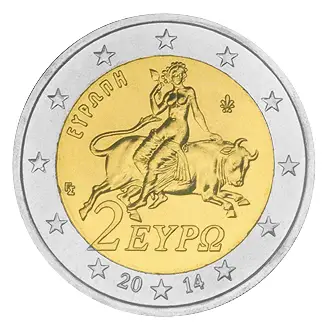
The symbol € is based on the Ancient Greek version of epsilon, Є, with two parallel lines meant to symbolise stability.
Spelling and pronunciation
Even though the word ‘euro’ was coined by a Belgian Esperantist and officially adopted in Madrid, because of its Ancient Greek roots, it is treated differently to other loanwords in Modern Greek:
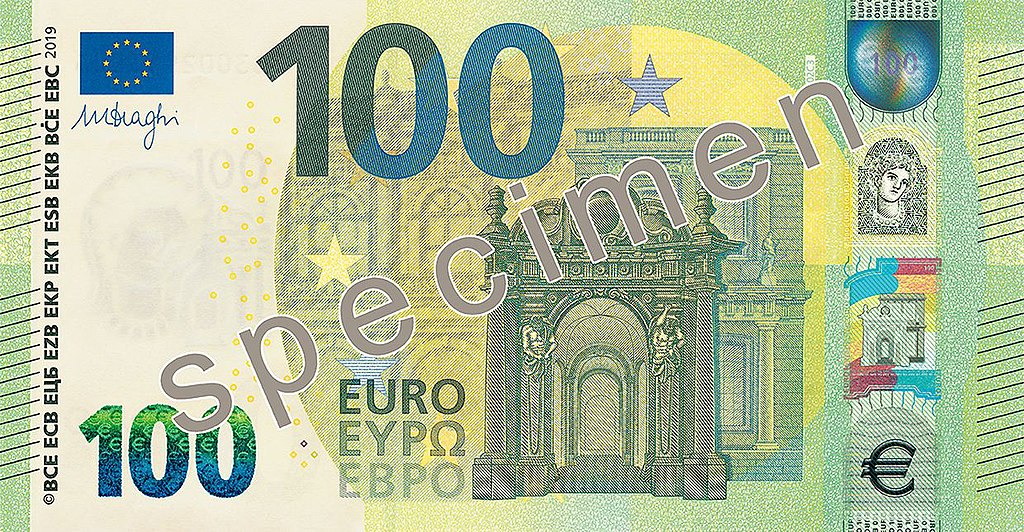
Current euro notes show the name of the currency in capitals in three different scripts: Latin (EURO, commonly pronounced ‘yoo-ro’ or ‘ev-ro’ depending on location), Greek (ΕΥΡΩ, pronounced ‘ev-ro’), and Cyrillic (ΕΒΡΟ, also pronounced ‘ev-ro’). You can also see ΕΥΡΩ written on the obverse side of euro coins minted in Greece.
Cents
The euro is broken up into 100 cents, called λεπτά in Greek.
The Ancient Greek λεπτός referred to something small, a thin sliver or fine grain.
In Modern Greek, ένα λεπτό means both one minute (a sliver of an hour), and one cent (a sliver of the euro). The plural is λεπτά.
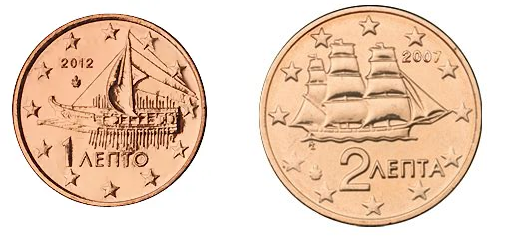
You can see ΛΕΠΤΟ written in capitals on the 1 cent coin, and ΛΕΠΤΑ on every coin worth multiple cents.
Prices
Try reading the following prices out loud:
- €4.12 (τεσσερα ευρώ και δώδεκα λεπτά)
- €2.20 (δύο ευρώ και είκοσι λεπτά)
- €1.30 (ένα ευρώ και τριάντα λεπτά)
Capitalisation and pluralisation
Note that, as in English, the name of the continent Ευρώπη (Europe) is written with a capital, but the name of the currency ευρώ (euro) is not.
Note also that the plural of ευρώ is simply ευρώ. While neuter nouns ending in an omicron like λεπτό typically have a plural form ending in -α, like λεπτά, the word ευρώ is an indeclinable neuter noun. It doesn’t change: ένα ευρώ, δύο ευρώ.
Now, listen to the conversation between Marina and the kiosk owner on the Nostos Website. Try to identify the word Marina uses just before she hands over the money. (Hint: initially, she tries to give the kiosk owner 10 euro, but when they ask for smaller change (ψιλά) she uses the same word again when handing over 5 euro)
Making payment and receiving change
Did you notice what Marina said when she handed over the money?
The word ορίστε means something like ‘here you are’.
Take a look over the dialogue printed on page 53 of Ελληνικά Τώρα (Greek Now) 1+1. See if you can find all 4 uses of ορίστε.
The first two examples are where the kiosk owner is handing over a product Marina has requested. Note that the first time, he (we can assume ‘he’ because περιπτεράς is masculine) follows this by asking Θέλετε τίποτα άλλο; (Do you want anything else?) This is a very common phrase in service settings like shops.
The next two examples are where Marina is handing over the money to pay.
At the end of the dialogue, the περιπτεράς calls out after Marina – she has forgotten something. Τα ρέστα σας means ‘your change‘.
Note that there are two different words for change in this dialogue:
- ψιλά refers to small change, i.e. a small note, or coins.
- ρέστα refers to the change you are owed from a transaction.
You can remember ρέστα as in ‘the rest-a my money’!
Ορίστε can also be used when giving change: Ορίστε τα ρέστα σας.
Now, turn to page 19 of the Ελληνικά Τώρα (Greek Now) 1 workbook and listen to the dialogue once more as you fill in the gaps.
Next, complete the exercises on page 53 in the textbook. If you have conversation partner, try acting out the scenario at the bottom of the page. If not, simply read the dialogue out loud.
Now, return to page 19 in the workbook and answer the questions marked I and II.
BONUS: Larger sums
Now that you know how to count up to a billion (!!) and understand how money works in Greece, you might like to watch this Easy Greek video on what Greeks would do if the had a large sum of money. Don’t worry about understanding everything – just see if you can pick out the word ‘ευρώ’ and some of the numbers, and familiarise yourself with the sounds of the language spoken naturally.
 greek_ciwm2e