If you’re planning a trip to Greece or Cyprus, understanding how to communicate with hotel staff (or a short-term rental host!) is useful.
The Greek word for hotel is ξενοδοχείο. It’s a bit of a long word, so it helps to break it down. The word comes from the Ancient Greek ξένος (foreign) and δοχεῖον (holder). So, a ξενοδοχείο is a place to hold foreigners – a hotel!
Floors of a building
The floors of a building are labelled differently in different places throughout the world.
Take a look at these elevator buttons:
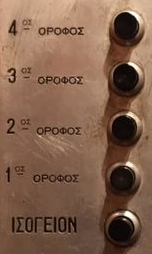
In North America, Russia, China, and some parts of Asia and South America, the floor you enter from the street is called the first floor. But, in Africa, Oceania, most of South America and Asia, and all of Europe (including Greece), the floor you enter from the street is called the ground floor (or some variation, like ισόγειον, seen above).
| Terrace | ταράτσα |
| 4th floor | τέταρτος όροφος |
| 3rd floor | τρίτος όροφος |
| 2nd floor | δεύτερος όροφος |
| 1st floor | πρώτος όροφος |
| Ground floor | ισόγειο |
| Basement | υπόγειο |
The rooftop of a building (if accessible as a terrace) is called the ταράτσα. Notice how similar ‘terrace‘ and ‘ταράτσα’ sound? Greek borrowed this term from the Italian terrazza, which, in turn, came from the Old French terrasse, which is where English likewise borrowed ‘terrace’ from.
Το ισόγειο is Greek for ‘the ground floor’. It literally means equal with the ground. (Think of ‘isotonic’ meaning ‘same concentration’, and ‘geothermal’ meaning ‘ground heat’).
Relatedly, το υπόγειο signifies ‘the basement’. It literally means underground. (Think of ‘hypodermic’ meaning ‘under skin’).
Between ισόγειο and ταράτσα, floors are given numbers.
The numbers we’ve learned so far are cardinal numbers used for counting (1, 2, 3, 4…).
In Greek, as in English, ordinal numbers (1ST, 2ND, 3RD, 4TH…) are for indicating the order of floors :
- πρώτος όροφος
- δεύτερος όροφος
- τρίτος όροφος
- τέταρτος όροφος…
Notice how they all end with -ος, as shown in the image of elevator buttons above (1ΟΣ, 2ΟΣ, 3ΟΣ, 4ΟΣ…)
The connection between δύο and δεύτερος, τρία and τρίτος, and τέσσερα and τέταρτος is fairly clear.
But just like ‘one’ and ‘first’ in English, the relationship between ένα and πρώτος may not be immediately obvious. Think of ‘prototype’ (a first model).
If you live in an apartment building, practice saying what floor you live on: Μένω στον… όροφο.
Notice how in this sentence, we use the accusative όροφο rather than the nominative όροφος. You (the one doing the living) are the subject, and the floor (the one being lived on!) is the object, so we use στον and drop the –ς.
Rooms of a hotel
The word for ‘room’ as in a bedroom or hotel room is δωμάτιο.
Its common for hotel rooms to be sold as single, double, or triple occupancy.
In Greek, the relevant words end with –κλινο:
| single room | μονόκλινο δωμάτιο |
| double room | δίκλινο δωμάτιο |
| triple room | τρίκλινο δωμάτιο |
Once again, the connection between δύο and δίκλινο, and τρία and τρίκλινο is fairly clear.
But, just like ‘one’ and ‘single’ in English, the relationship between ένα and μονόκλινο may not be immediately obvious. Think of ‘monochrome’ (single colour).
Above three beds, you can simply indicate the number: Ένα δωμάτιο με τέσσερα κρεβάτια.
Making a reservation in person
Take a look at the vocabulary on page 14 of Λοιπόν, τι λες; (Well, what do you say?).
Then, listen to the Θέλω ένα δωμάτιο dialogue, and complete the activities on page 60 in Ελληνικά Τώρα 1+1.
Next, turn back to page 14 and match the phrases with the appropriate responses. Try reading it out loud to practice making a reservation in person.
Making a reservation online
Of course, it is very common to make reservations online rather than in person. Activity 3 on page 15 of Λοιπόν, τι λες; as an example of a booking website in Greek.
Look up any words you don’t understand or can’t guess from the context, and then play around with some real searches on the Greek Hotels website.
Making a reservation by telephone
Sometimes, you may find a hotel or room for rent you like the look of online, but they may not accept online bookings. Or, you may want to call to ask for room on a particular floor or with a particular bed configuration.
Activity 4 on page 15 has three examples of places to stay: ξενοδοχείο (hotel), ενοικιαζόμενα δωμάτια (rooms for rent) and παραδοσιακός ξενώνας (traditional guest house).
Imagine you have pressed the Κλήση (call) button on each of these listings and are speaking to the staff. Use the dialogue on page 60 of Ελληνικά Τώρα 1+1 as an example. If you have a conversation partner, take turns playing the υπάλλξλος (employee).
There’s a great LinguaTree video on why Iouli prefers rental homes over hotels. You don’t need to understand everything she says – that’s why there are subtitles! – but you can listen out for some of the vocab we’ve covered today:
At the hotel
Once you’ve made your reservation, whether in person, online, or by phone, you’ll want to know how to communicate. Stalo’s video covers some of the most important phrases you’ll use at a hotel, starting with confirming your reservation by name, or the code you received on a booking site.
Treat this as a preview! All you need to remember at this stage are the words for hotel and room, and that the floors of a building end with -ος, and room occupancy descriptions end with –κλινο!
 greek_ciwm2e